GEOTECHNICAL ENGINEERING
SAINT JOHN NB
HomeGround improvementVibrocompaction design

Vibrocompaction Design for Saint John NB Soils

Knowledgeable. Thorough. Resourceful.

LEARN MORE

Saint John sits at 45.2788°N where the St. John River meets the Bay of Fundy. The city's 2023 building permit values surpassed $120 million, much of it on glacially consolidated soils. Vibrocompaction design here must account for dense basal till abruptly transitioning to compressible marine silts. We run this program directly from the lab bench to the field rig. Grain-size distributions from the grain-size module define the gradation envelope before any probe goes in. The 2018 east-end commercial developments showed 18 m of variable fill overlying weathered bedrock. Standard SPT refusal at 12 m meant a sondaje SPT correlation check was essential for verifying target relative density. Every Saint John project starts with a specific particle-size question. We answer it before designing the grid.

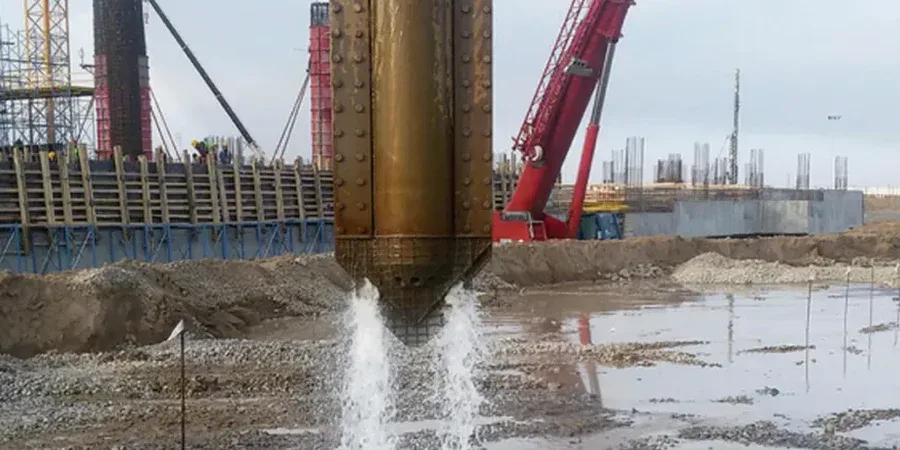
Vibrocompaction design in glacial till requires a different probe energy profile than marine sand. We define both from particle-size data.
Our service areas

Our approach and scope

Uptown Saint John sits on dense glacial till with cobbles and boulders. Millidgeville slopes toward the river on softer estuarine deposits. The vibrocompaction design changes radically between these two neighborhoods. Uptown requires high-energy bottom-feed systems to displace large clasts. Millidgeville demands top-feed methods with controlled water injection to prevent pore pressure buildup in silty lenses. We calibrate probe spacing using CPT tip resistance profiles. Target relative density is set at 70% minimum below footings. The compaction point grid is triangular at 2.1 m spacing for clean sands. Silt content above 12% triggers a switch to stone column reinforcement. Each design package includes settlement verification curves based on Schmertmann's method. Frequency and amperage logs are specified in the field protocol for every compaction point.
Vibrocompaction Design for Saint John NB Soils
Technical reference — Saint John NB

Local geotechnical context

We run a 180 kW electric vibroflot with data acquisition logging amperage, depth, and pull-down force every 100 mm. In Saint John's Lancaster area, we hit buried timber cribbing from 19th-century wharf construction. The probe goes in. The logs spike. The design adjusts. That's the risk. Undetected obstructions bend the probe. Pore pressure in confined silt pockets can liquefy the surrounding matrix during vibration. We specify pore pressure dissipation holds in the compaction sequence. Over-compaction in clean sands wastes energy and can fracture adjacent shallow footings. Under-compaction leaves loose zones that settle differentially under the first freeze-thaw cycle. Saint John's tidal groundwater fluctuation of 6 m amplifies effective stress changes. The compaction protocol must account for that cycle.

Need a geotechnical assessment?

Reply within 24h.

Email: info@geotechnical-engineering.org

Watch the video

Regulatory framework

NBCC 2015 Division B, Part 4 Structural Design, CSA A23.3 Design of Concrete Structures, soil bearing references, ASTM D4253 Standard Test Methods for Maximum Index Density of Soils, ASTM D4254 Standard Test Methods for Minimum Index Density of Soils

Technical data

ParameterTypical value
Design basisNBCC 2015 Division B, CSA A23.3
Minimum target relative density70% below footings
Grid patternTriangular, 1.8–2.5 m spacing
Probe typeElectric or hydraulic, 130–180 kW
Verification methodCPT before/after, SPT correlation
Settlement criterion25 mm maximum post-construction
Fines threshold for method changeSilt content >12%

Quick answers

What does vibrocompaction design cost in Saint John?

Design fees for a standard commercial lot in Saint John range from CA$2,120 to CA$7,490. The spread depends on the number of compaction points, verification testing density, and whether we need to run supplemental grain-size analysis for variable fill materials.

How do you verify that the design worked?

We run CPT soundings at pre-selected verification points before and after compaction. The tip resistance increase is correlated to relative density using the Baldi method. We also run SPT checks at 1 per 300 m² of treated area as a redundant verification per NBCC recommendations.

What soil types in Saint John respond best to vibrocompaction?

Clean sands with less than 12% passing the #200 sieve respond best. The glacial outwash deposits along the St. John River valley are ideal. The marine silts in Millidgeville are borderline and often require a hybrid approach with stone columns at the perimeter.

How deep can the vibroflot reach in Saint John conditions?

Our standard 180 kW rig reaches 25 m depth in loose sand. In Saint John's glacial till with cobbles, we typically achieve 15–18 m before refusal. We design the grid with primary points at 15 m spacing and secondary infill points for the upper 10 m zone.

Location and service area

We serve projects in Saint John NB and surrounding areas.

View larger map