GEOTECHNICAL ENGINEERING
SAINT JOHN NB
HomeGeophysicsSeismic tomography (refraction/reflection)

Seismic Tomography for Site Investigation in Saint John NB

Knowledgeable. Thorough. Resourceful.

LEARN MORE

In Saint John, many project sites sit on a complex mix of glacial till overlying fractured bedrock, and what you see at surface rarely tells the whole story. We've worked on plenty of jobs where a conventional borehole hit refusal at three meters, but the neighboring lot had a buried channel filled with soft silts extending twice that depth. Seismic tomography cuts through that guesswork by mapping the velocity structure of the subsurface in two dimensions, which lets you see how competent the rock actually is and where the transitions happen. For developers dealing with the city's sloping terrain north of the Reversing Falls, this kind of continuous profile is far more useful than point data alone. We often recommend pairing the tomography grid with a few targeted test pits to ground-truth the velocity boundaries against visible soil strata, especially in areas where the Wisconsinan till is thin and the underlying Cambrian metasediments are highly variable.

A velocity tomogram doesn't just show you where the bedrock is—it shows you whether that bedrock is worth building on.
Our service areas

Our approach and scope

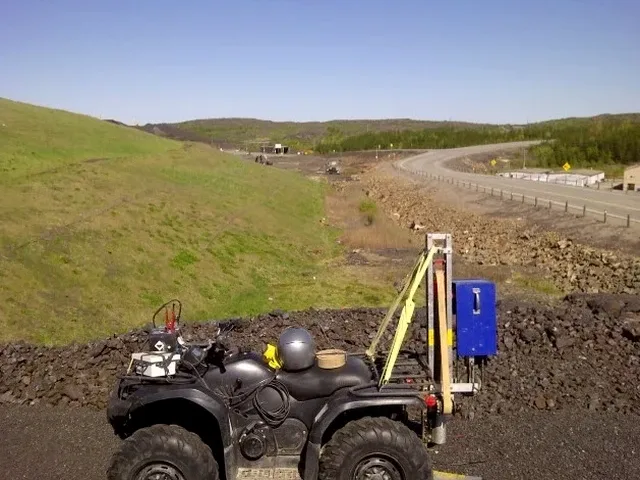
The field setup we deploy around Saint John typically uses a 24-channel seismograph with a spread of geophones spaced anywhere from one to five meters apart, depending on how deep you need to see. The source is usually a sledgehammer on a steel plate for shallow refraction work up to about 30 meters, but we switch to a weight drop or a small explosive charge when the target is deeper bedrock mapping in the reflection mode. The key output is a tomographic velocity model that highlights zones of low-velocity weathered rock, voids, or water-filled fractures—exactly the kind of defects that cause settlement problems later on. Because the survey is non-invasive, we can work right through an active construction site without disturbing ongoing earthworks. When the velocity contrast is subtle—say, between a dense till and a moderately weathered sandstone—we sometimes cross-check the tomographic interpretation with a MASW survey to separate stiffness from density, which gives the geotechnical engineer a clearer picture for foundation design.
Seismic Tomography for Site Investigation in Saint John NB
Technical reference — Saint John NB

Local geotechnical context

With a population of around 70,000 and a building stock that ranges from 19th-century masonry to modern steel frame, Saint John sits in a moderate seismic zone under the NBCC 2015 hazard model, with a 2% in 50-year spectral acceleration that demands honest site-class determination. Skipping the velocity profile in a city built on a Paleozoic bedrock basin means you could be assigning a Site Class C when the actual conditions under the till are closer to an E—and that difference translates directly into higher seismic design forces and more expensive lateral systems. We have seen projects where a reflection tomography line across the proposed footprint revealed a steep bedrock slope that would have concentrated earthquake energy right under one corner of the building, something no amount of drilling on its own would have caught. The investment in a proper tomographic survey is minor next to the cost of redesigning foundations after excavation exposes what the boreholes missed.

Need a geotechnical assessment?

Reply within 24h.

Email: info@geotechnical-engineering.org

Regulatory framework

NBCC 2015 (National Building Code of Canada) seismic hazard provisions, CSA A23.3-14 Design of Concrete Structures, ASTM D5777-18 Standard Guide for Using the Seismic Refraction Method, ASTM D7128-18 Standard Guide for Using the Seismic Reflection Method, Canadian Geotechnical Society (CGS) Engineering Geology Division guidelines

Technical data

ParameterTypical value
MethodologySeismic refraction and reflection tomography, P-wave and S-wave
Typical investigation depth5 m to 120 m, depending on source energy and geophone spread
Geophone configuration24 to 48 channels, vertical and horizontal component geophones
Source typesSledgehammer, accelerated weight drop, or small explosive charge
Primary deliverable2D velocity model with interpreted geological boundaries
ComplianceNBCC 2015, CSA A23.3, ASTM D5777-18 guidelines
Data processingRay tracing and inversion with elevation correction and topographic modeling

Quick answers

How much does a seismic tomography survey cost in Saint John?

For a typical site investigation in the Saint John area, project budgets generally fall between CA$3,490 and CA$7,440. The final figure depends on the number of seismic lines, the geophone spacing, the required depth of investigation, and the mobilization logistics to your site. A small residential lot with one or two refraction lines costs less than a multi-line reflection survey for a commercial development. We provide a fixed-price proposal after reviewing your site plan and geotechnical objectives, so there are no surprises halfway through the job.

What is the difference between seismic refraction and reflection tomography?

Refraction tomography measures the travel time of seismic waves that bend along velocity boundaries and return to the surface, which works best for mapping a gradual velocity increase with depth—ideal for finding the top of competent bedrock. Reflection tomography captures energy that bounces off sharp acoustic impedance contrasts, so it is better for imaging discrete layers, faults, or voids at greater depths. In Saint John, where the bedrock surface can be irregular and weathered, we often combine both techniques in the same survey to get a complete picture of the shallow overburden and the deeper structure.

Can seismic tomography work in urban areas of Saint John with traffic and underground utilities?

Yes, but it requires careful planning. Urban noise from traffic and machinery can degrade the signal quality, so we typically schedule acquisition during quieter hours and use stacked impacts to improve the signal-to-noise ratio. Underground utilities like water mains and gas lines do not interfere with the seismic signal, but we always obtain a utility locate before laying out the geophone spread. The method is entirely surface-based and non-invasive, so it is safe to use right next to existing buildings and buried infrastructure without any risk of damage.

Location and service area

We serve projects in Saint John NB and surrounding areas.

View larger map