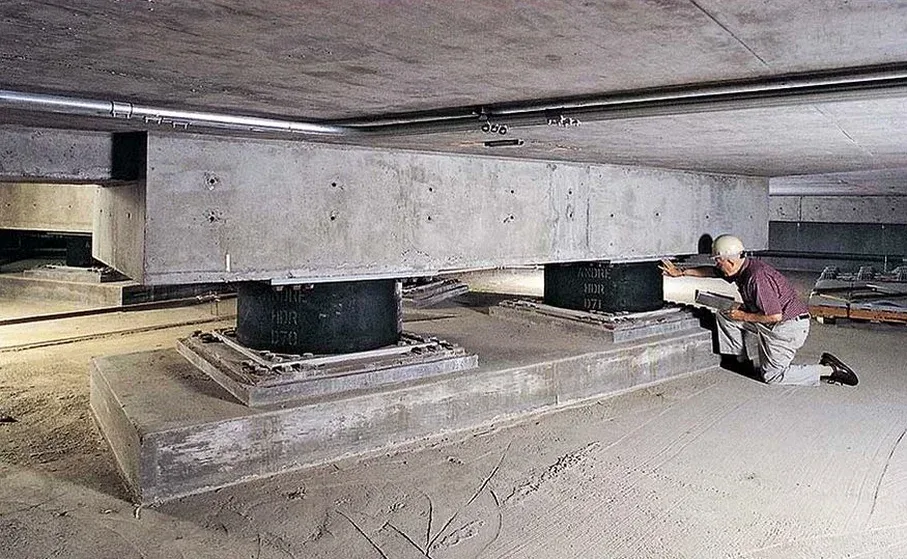
The bearing test frame in our lab runs at 1,000 kN capacity. That is the machine used to validate every isolator before it ships to a site in Saint John. We run full-scale prototypes through three cycles at design displacement. Saint John sits on the Bay of Fundy, and the 2015 National Building Code update raised the spectral acceleration values for this region. New construction above three storeys in the uptown peninsula now triggers seismic review. The bedrock under Saint John is competent Cambrian metasediment. But the overburden, especially near the harbour and Marsh Creek, contains soft marine clay lenses that amplify motion. A fixed-base structure on those soils takes the full ground acceleration. A properly tuned seismic isolation system cuts the spectral demand by half or more. We test lead-rubber bearings and curved surface sliders. We also run the triaxial shear suite on the soil beneath the isolation plane to confirm stiffness and damping for the time-history model. Saint John has older masonry buildings on King Street and modern steel frames on the east side. Both benefit from isolation when the numbers show a 20–40 percent reduction in drift. Our lab follows CSA A23.3 and the NBCC 2020 provisions for seismic isolation. We do not guess at parameters. We measure them under load and displacement control.
An isolator tested at 200 mm displacement in the lab is safer than one assumed to work from a catalog curve.