GEOTECHNICAL ENGINEERING
SAINT JOHN NB
HomeInvestigationSPT (Standard Penetration Test)

SPT Testing in Saint John NB: Reliable Subsurface Data for Your Project

Knowledgeable. Thorough. Resourceful.

LEARN MORE

The soil conditions on the Saint John peninsula can vary dramatically within a single city block. A project in the historic Trinity Royal district might encounter dense glacial till just a few meters down, while a site out toward Millidgeville often sits on softer marine clays deposited by the ancient sea that once covered the Saint John River valley. This variation is the primary reason geotechnical engineers in Saint John NB rely so heavily on the Standard Penetration Test (SPT). The test provides a numerical measure of soil density—the N-value—which is fundamental to calculating bearing capacity and predicting settlement. For sites near the reversing falls or the harbor, where bedrock depth can shift unexpectedly, integrating SPT data with geophysical surveys helps map the subsurface without excessive drilling. A well-executed SPT program in Saint John NB also informs the selection of deep foundations when near-surface soils lack the needed strength.

An SPT N-value is only as reliable as the driller's adherence to energy calibration—in Saint John's variable till, that precision defines the foundation's safety.
Our service areas

Our approach and scope

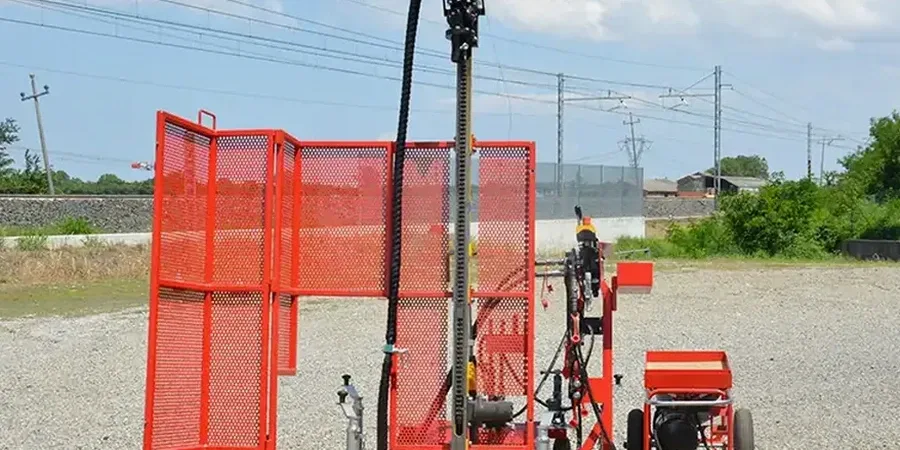
Saint John's coastal climate presents a distinct challenge: saturated soils from frequent fog and rain can produce misleadingly low N-values if the borehole isn't properly cased. The local geology, shaped by the Wisconsin glaciation, leaves a legacy of compact lodgement till interspersed with zones of loose ablation material. When the drill encounters a sudden change in resistance, the split-spoon sampler must advance a full 450 mm to ensure the recorded N-value reflects the true in-situ condition and not just a large cobble. Our process follows CSA A119.1 guidelines, with automatic trip hammers calibrated to the standard 63.5 kg weight and 760 mm drop. In the east end of Saint John NB, where fill material overlies natural deposits, we often combine the SPT with grain size analysis to confirm the composition of the artificial layer. For deeper investigations, the results can be correlated with CPT soundings to develop a continuous strength profile.
SPT Testing in Saint John NB: Reliable Subsurface Data for Your Project
Technical reference — Saint John NB

Local geotechnical context

Saint John sits within the Northern Appalachians seismic zone, and the 2015 NBCC assigns the city a moderate seismic hazard rating. Loose, saturated sands in the lower West Side and near Marsh Creek are susceptible to strength loss during shaking, a condition that cannot be diagnosed without penetration resistance data. Relying solely on hand augers or visual inspection misses the critical information that SPT N-values provide about liquefaction potential at depths of 5 to 15 meters. Over the hard bedrock that underlies much of Uptown Saint John, shallow refusal can occur abruptly; mistaking a boulder for the top of bedrock can lead to an overly conservative foundation design. A dense array of SPTs, supplemented by liquefaction analysis, is the only way to differentiate isolated obstructions from the true bearing stratum and to satisfy the geotechnical requirements of the Saint John building permit process.

Need a geotechnical assessment?

Reply within 24h.

Email: info@geotechnical-engineering.org

Regulatory framework

ASTM D1586 – Standard Test Method for Standard Penetration Test (SPT) and Split-Barrel Sampling of Soils, NBCC 2015 – National Building Code of Canada, Part 4: Structural Design, CSA A23.3 – Design of Concrete Structures (references to geotechnical input for foundation design)

Technical data

ParameterTypical value
Hammer typeAutomatic trip, 63.5 kg
Drop height760 mm (30 in)
Standard samplerSplit-spoon, 50 mm O.D.
Test intervalEvery 1.5 m depth or strata change
N-value correctionOverburden and energy ratio (N60)
Sample recoveryDisturbed sample for classification
Seating drive150 mm before test count
Reporting standardASTM D1586 / NBCC 2015

Quick answers

What does an SPT test typically cost for a residential lot in Saint John?

For a standard single-family home lot in Saint John, an investigation with two to three boreholes typically ranges from CA$800 to CA$1,140, depending on access for the drill rig and the total depth required to reach competent bearing soil or bedrock.

How deep do you typically need to drill for an SPT in Saint John NB?

Depths vary widely by location. In the Uptown and South End areas, refusal on bedrock may occur within 3 to 5 meters. In the Millidgeville or Grand Bay regions, where marine clays are thicker, boreholes often extend to 15 meters or more to investigate potential settlement layers.

How are the SPT results used to design my foundation?

The N-values are correlated to soil friction angle and undrained shear strength. These parameters feed directly into bearing capacity equations from the NBCC and CSA A23.3, allowing the structural engineer to size footings or determine the required length and capacity of driven piles.

Can you perform SPT testing during the winter months in Saint John?

Yes, we operate year-round. Frozen ground at the surface requires pre-drilling with a rock bit or casing, but once through the frost layer—which in Saint John can reach 1.2 meters—the SPT procedure proceeds normally. The energy corrections account for the temperature effects on the hammer hydraulics.

Location and service area

We serve projects in Saint John NB and surrounding areas.

View larger map